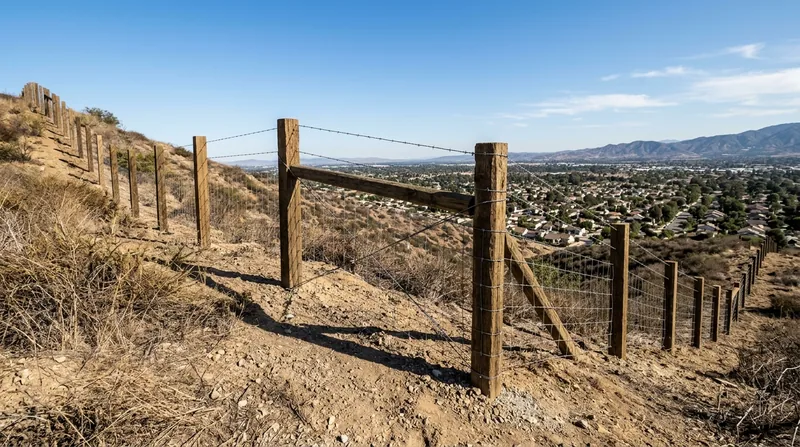




Farm fence installation in Los Angeles spans the larger hillside and canyon properties across the region, where acreage and livestock containment demands differ sharply from suburban privacy fencing. Properties in the foothills and rural edges of Los Angeles, Culver City, and surrounding areas face unique challenges: decomposed granite and shallow bedrock, seasonal drought followed by winter saturation, Santa Ana wind gusts that test post footings, and salt air near the coast that corrodes unprotected steel and fasteners. We set post lines deep enough to hold through the dry season and the wet, run wire and rail across slopes that require racked or stepped installation depending on grade, and use materials and methods built for the long term on acreage.
Why Farm and Ranch Fencing Matters in Los Angeles Hillside and Canyon Properties
Acreage properties in the Los Angeles area demand fencing that performs over decades and across terrain where a standard suburban approach fails. Shallow rock, high wind exposure, and the swing between drought-tight and water-logged soil means posts loosen over time if they are not set properly from the start. A fence that contains livestock, marks a property line, or protects a pasture is infrastructure, not decoration, and it must be built to code and to the land.
- Set posts in concrete to minimum depth and width required by soil and wind exposure on your lot.
- Run split rail, pipe, or wire fencing across slopes using racked or stepped methods to follow grade without gaps.
- Use galvanized or powder-coated hardware and fasteners to resist rust in Los Angeles' variable climate and coastal salt air.
- Verify height, setback, and material rules with your local building department and HOA before starting work.
- Plan for California 811 utility locates before any post hole is dug, required by law to avoid buried power, gas, and water lines.
Proper farm and ranch fencing protects your investment and ensures your property is secure and compliant with local code.
Key info: Hillside properties in Los Angeles and Pasadena often face racked installation requirements where standard posts and rails must angle to follow steep slopes. We assess your lot's grade, drainage, and wind exposure on-site to set the right footing depth and choose between racked and stepped methods. See the Los Angeles County Department of Public Works for setback and height rules in unincorporated areas.
How We Install Farm and Ranch Fencing in Los Angeles: Step by Step
Farm and ranch fencing on acreage starts with a clear understanding of your property line, soil conditions, and the specific containment or boundary goal. We work from your existing survey and install on the line you identify, assess the terrain and wind exposure to set post depth and spacing, and choose materials and methods that hold up through Los Angeles' dry summers and wet winters. Every lot is different, and the build is planned lot by lot rather than by a regional default.
- Request a California 811 utility locate to mark buried lines before any digging begins, required by law.
- We visit your property, assess slope, soil, drainage, and wind exposure to determine post depth and spacing.
- Mark the fence line and set posts in concrete at the depth and width your lot requires, spaced per code and load.
- Install split rail, pipe, wire, or barbed wire fencing across the line, using racked or stepped installation if your lot has slope.
- Check plumb and tension, trim excess material, and clean up the job site.
The result is a fence that performs on acreage and holds through years of Los Angeles weather.
Local example: A 5-acre property in the Santa Clarita foothills with decomposed granite and a 15-degree slope required racked installation and posts set 4 feet deep in concrete to hold against Santa Ana winds. We ran split rail fencing across the property line, staggered the rails to follow grade, and used galvanized fasteners throughout. The fence has held for five years without a loose post, and the owner has confidence the line is secure.
Farm and Ranch Fencing Methods: Choosing the Right Approach for Your Land
| Approach | Description | Best For |
|---|---|---|
| Split Rail Fencing | Posts set in concrete with horizontal rails mortised or nailed into place, classic rural look, requires racking on slopes. | Property boundaries, pasture containment, aesthetic appeal on acreage. |
| No-Climb Horse Fence | Rigid wire mesh welded to posts, prevents horses and livestock from climbing or getting hooves caught, durable and safe. | Horse paddocks, livestock containment, areas where safety and durability are priorities. |
| Pipe Fencing | Steel or aluminum pipe set in concrete, welded or bolted at joints, high strength and minimal maintenance when galvanized. | Heavy-duty containment, high wind exposure, properties where strength and longevity matter most. |
| Barbed Wire Fencing | Tensioned wire strung between posts, lowest material cost, requires regular tension checks and post maintenance. | Large acreage, cattle containment, budget-conscious property lines where wire alone is sufficient. |
Each method is suited to a specific use and terrain. We help you choose based on your animals, slope, wind exposure, and long-term maintenance tolerance. Learn more about our fence repair services if your existing farm fencing needs attention.
Farm and Ranch Fencing Cost in Los Angeles: What to Expect
Farm and ranch fencing on acreage in Los Angeles starts at $15 per linear foot for basic split rail or wire fencing on level terrain with good access. That cost rises with slope, soil conditions, post depth, material choice, and terrain difficulty. A property with decomposed granite, steep grade, or limited access to run equipment costs more per foot because post holes take longer to dig and racking the fence line adds labor. Barbed wire on large acreage costs less per foot than no-climb horse fence or pipe fencing, which are heavier materials and require more skill to install.
The best way to know what your job will cost is to get two or three estimates from contractors who will visit your property, assess the terrain, and give you a realistic price based on what is actually there. We offer a free estimate at (323) 859-1615, with a response within 24 hours. See our full pricing overview for more detail on factors that move the cost and typical ranges across fence types.
Factors that affect the cost of farm and ranch fencing include post depth and spacing set by soil and wind, material choice (split rail, pipe, wire, or no-climb mesh), slope and racking labor, access for equipment, and whether the posts are set in concrete or tamped (concrete is more durable and is our standard). Winter estimates may be higher if the ground is saturated or recent storms have loosened soil.
Farm and Ranch Fencing Near Me: What Los Angeles Homeowners Should Know When Hiring
Hiring a fence contractor for acreage work in Los Angeles means checking insurance, understanding how licensing works in California, getting multiple estimates, and verifying that the contractor knows how to handle your specific terrain and material. California requires a C-13 Fencing Contractor license for any fence project that reaches $1,000 in combined labor and materials or requires a building permit. That license is mandatory and carries a $25,000 bond. Insurance and workers' compensation cover are essential, because farm and ranch fencing involves digging deep holes, setting heavy posts, and working on slopes where injury risk is real.
Ask for a certificate of insurance showing general liability and workers' compensation coverage before work starts. Get written estimates from at least two contractors, and ask how they handle your lot's specific challenges: slope, soil type, wind exposure, and utility locate requirements. Check references from past acreage projects in the Los Angeles area, and ask whether the contractor has experience with racked installation, post depth decisions, and the soil and drainage conditions on hillside properties. Verify that your local building department and HOA (if applicable) have approved the fence height, setback, and material before you commit.
Call us at (323) 859-1615 or request a free estimate online to discuss your property, get answers to your questions, and receive a detailed price for your farm or ranch fencing project.
Farm & Ranch Fencing in Los Angeles: Pricing Guide
| Service | Price | Details |
|---|---|---|
| Split Rail Fencing | Starting at $15/ft | Posts set in concrete, horizontal rails, classic rural look, cost rises with slope and post depth required |
| No-Climb Horse Fence | Starting at $18/ft | Welded wire mesh on posts, safe for livestock, durable, cost varies with mesh gauge and terrain difficulty |
| Pipe Fencing | Starting at $20/ft | Steel or aluminum pipe, high strength, galvanized or powder-coated, cost reflects material and welding labor |
| Barbed Wire Fencing | Starting at $8/ft | Tensioned wire on posts, lowest cost option, suited to large acreage and cattle containment |
| Complex terrain or large acreage | On estimate | Racked installation, shallow rock, high wind exposure, or limited equipment access require on-site assessment |
| Free estimate | No obligation | Response within 24 hours at (323) 859-1615, includes site visit and detailed pricing for your property |
Indicative pricing, the exact cost depends on square footage, finish, and site access. Free personalized estimate within 24h at (323) 859-1615.


