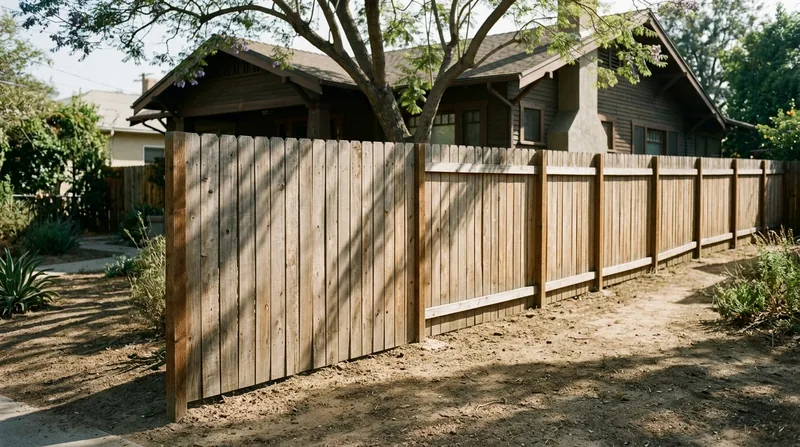




Privacy fence installation in Los Angeles requires more than standard framing: the region's variable terrain, Santa Ana wind loads, and the swing between dry summers and saturated winters demand that posts be set deep and footings sized to the lot itself. From Craftsman bungalow streets in Los Feliz to post-war neighborhoods in Torrance, wood privacy fencing remains the most common choice for property boundaries, sight lines, and sound buffering. Soil shrink and swell across the greater Los Angeles area work posts loose over years if they are not set correctly from the start. We install cedar and pressure-treated pine privacy fence on slopes, in tight spaces, and on wind-exposed ridges where the standard installation won't hold. Since 2013, we have built fences that last by setting each post to the soil and exposure of its own lot, not to a regional default.
Why Wood Privacy Fencing Matters in Los Angeles: Wind, Soil, and Sight Lines
Los Angeles homeowners choose wood privacy fence for reasons that go beyond aesthetics. A well-built fence screens views, blocks sound from adjacent properties and streets, and defines the boundary in neighborhoods where lot lines are sometimes unclear. The region's Santa Ana winds load long fence runs each autumn, and a post set shallow or in tamped soil alone will drift and fail within a few seasons. The ground swells when winter rains saturate the clay and silt found across much of the area, then shrinks during the dry season, working any loose post up and out of the earth. Near the coast, salt air and damp accelerate wood aging; inland, UV exposure bleaches and checks exposed wood and coating. A board-on-board or side-by-side privacy fence rated for these conditions protects your investment and your peace.
- Wood privacy fence blocks wind, noise, and sight lines from neighbors and street traffic across Los Angeles.
- Posts set in concrete and sunk 3 to 4 feet hold through soil shrink, swell, and Santa Ana wind loads.
- Cedar resists moisture and rot better than pressure-treated pine but costs more and requires maintenance.
- Board spacing, rail height, and post spacing are set by your city or county code and by HOA rules if your property is in a master-planned community.
- A racked fence follows the slope of the land; a stepped fence creates level sections on steep grades.
Your city or county building department sets fence height, setback, and material rules. Check the fence repair page for information on maintaining an existing fence, or call (323) 859-1615 to discuss your lot and what a new privacy fence will require.
Key info: A homeowner in Burbank built a 6-foot cedar privacy fence on a north-facing slope in 2015. The posts were set 48 inches deep in concrete, and the fence was racked to follow the grade. Ten years later, after two major winter storms and repeated soil shrink-swell cycles, the fence remains plumb and shows no signs of post movement. Proper footing depth and concrete set are what make the difference.
How We Install Wood Privacy Fence in Los Angeles: From Survey to Final Grade
Every wood privacy fence job in Los Angeles begins with a site walk. We identify the fence line using your existing survey or the line you mark, check for utility lines by calling 811 (required by California law before digging any post hole), and assess the slope, soil type, wind exposure, and any structures or trees that affect post placement. We measure the run, calculate post spacing (typically 6 feet on center for privacy fence), and determine whether the fence will be racked, stepped, or a combination of both. Once you approve the layout and material choice, we dig post holes to the depth required for your soil and wind exposure, set posts in concrete, allow the concrete to cure, then install rails, pickets, and cap. The entire job, from layout to final grade, takes precision and patience.
- We locate your fence line using your existing survey and verify it with you before we stake or dig.
- We call 811 to locate underground utilities and mark the safe zone before we dig any post hole.
- We dig post holes to 3 to 4 feet depth depending on soil type, wind exposure, and frost depth in your area.
- We set posts in concrete, not tamped soil alone, and allow concrete to cure before we attach rails or pickets.
- We install pressure-treated pine or cedar rails and pickets, with options for board-on-board, side-by-side, or shadowbox patterns.
- We trim and grade the site, and haul away all offcuts and debris.
The result is a fence that stands plumb and true, with no drift or settlement, for years to come. See our gate installation page if your privacy fence will include a gate.
| Approach | Description | Best for |
|---|---|---|
| Board-on-Board | Pickets overlap on alternating sides, creating a solid appearance with no gaps regardless of viewing angle. | Maximum privacy, sound blocking, and a finished look on both sides of the fence. |
| Side-by-Side | Pickets are installed flush against the rails on one side, creating a clean, solid appearance on that side and a rail view from the other. | Privacy and aesthetics on the interior side, cost savings compared to board-on-board, and a simpler maintenance profile. |
| Shadowbox | Pickets alternate front and back around the rails, creating a crisscross pattern that allows air flow and light while blocking sight lines. | Wind exposure, coastal properties where salt air is a factor, and homeowners who want privacy without a solid wall feel. |
| Racked Installation | The entire fence frame is tilted to follow the slope of the land, keeping pickets vertical and the fence face plumb to the eye. | Sloped lots across Los Angeles, including areas in Pasadena, Glendale, and the foothills, where a stepped fence would leave gaps at grade. |
| Stepped Installation | The fence is built in level sections that drop at intervals, following the contour of steep grades and keeping the fence frame square. | Very steep slopes where racking would create excessive strain on rails and posts, and where the stepped look is acceptable to the homeowner. |
Local example: A homeowner in Santa Monica needed a privacy fence on a coastal lot with salt air, high wind, and a 15-degree slope. We installed a shadowbox cedar fence, racked to the grade, with posts set 48 inches deep in concrete. The overlapping picket pattern allows the sea breeze to pass through without loading the posts, and the cedar is naturally resistant to salt damage. Two years in, the fence shows minimal weathering and no post movement.
Wood & Privacy Fence Installation Cost in Los Angeles: What to Expect
Wood privacy fence in Los Angeles typically starts at $34 per linear foot for a basic pressure-treated pine side-by-side fence, and rises to $50 to $70 per linear foot for cedar board-on-board or shadowbox. A 100-foot run of pressure-treated side-by-side fence costs roughly $3,400 to $4,000; a 100-foot run of cedar board-on-board runs $5,000 to $7,000. The final price depends on the species you choose (cedar costs more but weathers better), the pattern (board-on-board and shadowbox cost more than side-by-side), site access, slope (racked fences cost slightly more than level), and local labor rates. Soil type and footing depth also matter: a lot with poor drainage or high wind exposure may require deeper post holes or additional concrete, which adds cost. Getting 2 or 3 estimates from local installers helps you understand what the market is paying and what each contractor includes in their quote.
Call (323) 859-1615 or visit our pricing page for a detailed breakdown of materials, labor, and regional factors that affect your cost.
Wood & Privacy Fence Installation Near Me: What Los Angeles Homeowners Should Know When Hiring
Hiring a local fence contractor for wood privacy fence installation is a significant decision. You are trusting someone to work on your property, set posts correctly, and deliver a fence that will stand for a decade or more. Start by asking whether the contractor carries general liability and workers' compensation insurance and can provide a certificate on request. California requires a C-13 Fencing Contractor license for fence work once a project reaches $1,000 in combined labor and materials or requires a building permit; the law is the rule, not a claim we make about ourselves. Ask your contractor what permits your city or county requires, and whether an HOA review is needed if you live in a master-planned community. Get at least two estimates, compare the scope (material, labor, timeline, cleanup), and ask for references from recent projects. Check that the contractor calls 811 before digging and understands the slope and soil conditions on your lot. A good contractor will walk the site with you, explain why they are setting posts at a certain depth, and answer your questions about maintenance and warranty.
We are fully insured and an AFA Member Installer (American Fence Association), and we have been installing fences in Los Angeles since 2013. Contact us at our contact page or call (323) 859-1615 for a free estimate and site evaluation.
Wood & Privacy Fence Installation in Los Angeles: Pricing Guide
| Service | Price | Details |
|---|---|---|
| Pressure-Treated Pine Side-by-Side | Starting at $34/ft | Basic privacy fence, solid appearance on interior side, costs less than cedar and includes post concrete set and standard rail spacing |
| Cedar Board-on-Board or Shadowbox | $50-$70/ft | Premium material and pattern, cedar resists moisture and salt air better, full privacy or wind-permeable design, racked or stepped installation |
| Sloped or Difficult-Access Installation | On estimate | Racked or stepped fences, poor soil conditions, or tight site access require an on-site assessment before pricing |
| Travel and Site Evaluation | Included | No separate call-out or mileage fee within Los Angeles and surrounding service areas |
| Free Estimate | No obligation | Response within 24 hours, site walk and material consultation included, (323) 859-1615 |
Indicative pricing, the exact cost depends on square footage, finish, and site access. Free personalized estimate within 24h at (323) 859-1615.


