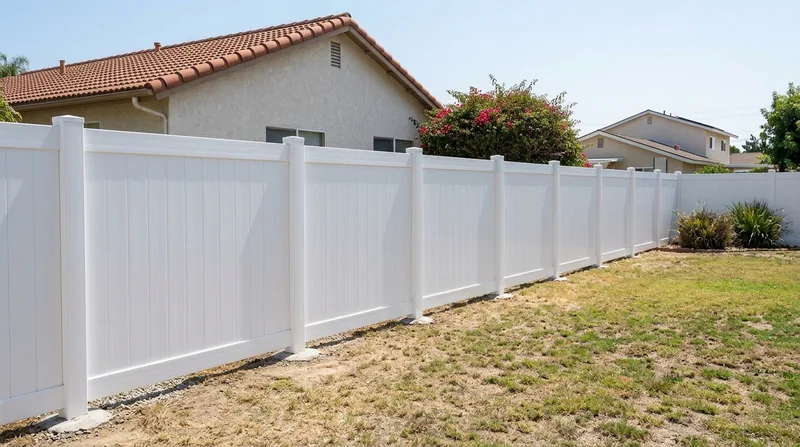




Vinyl fence installation in Los Angeles solves the durability challenge that wood faces in our region's extreme climate swings. From the coastal salt air of Santa Monica to the inland UV exposure of Pasadena, vinyl and PVC fencing hold their color and structural integrity without the rot, crack, or fade that plague wood over time. Los Angeles homeowners in single-family neighborhoods across Culver City, Beverly Hills, Torrance, and beyond choose vinyl because it requires no staining, no seasonal maintenance, and no replacement of rotted posts every decade. We install vinyl fencing on lots where soil shrink-and-swell from our dry summers and wet winters would work a wood post loose, and we set every post to match your yard's grade so water sheds away from the footing. Since 2013, we have run fence lines through the tract homes and newer developments that ring the basin, and we know how to spec posts and rails for the wind exposure and drainage conditions that vary sharply over short distances in this area.
Why Vinyl and PVC Fencing Makes Sense in the Los Angeles Climate
The Los Angeles climate punishes wood fencing. Winter storms saturate the soil and loosen posts set in tamped earth; the dry season pulls moisture from the ground and shrinks it, working posts loose all over again. Salt air near the coast accelerates wood decay and rusts galvanized fasteners. Inland, year-round sun fades paint and stain in a season or two. Vinyl and PVC eliminate these problems because they do not rot, do not crack from soil movement, and do not fade under UV exposure. A vinyl fence installed today will look the same in ten years, with no coating refresh, no board replacement, and no post re-setting.
- Vinyl does not absorb moisture, so posts stay tight in the concrete footing even as soil shrinks and swells through the year.
- Color is molded through the entire profile, not painted on the surface, so it will not fade, chip, or peel in Los Angeles sun.
- Vinyl rails and pickets are hollow but reinforced, so they will not warp, bow, or split like wood does when exposed to temperature swings.
- Fasteners and hardware are stainless steel or powder-coated, not galvanized, so they do not rust in coastal salt air or inland moisture.
- Maintenance is a rinse with the garden hose once or twice a year, not annual staining or sealing.
These advantages add up to a fence that stays upright, straight, and attractive without the repair cycle that wood requires in our region.
Key info: Homeowners in Redondo Beach and other coastal communities often see wood fence posts fail at the ground line within five to seven years because salt-laden air and damp soil accelerate decay. Vinyl fencing in the same locations will not rot, making it the smarter long-term investment despite the higher upfront cost.
For more on how vinyl compares to other materials, see our guide to wood and privacy fence installation and our full range of fencing options.
How We Install Vinyl and PVC Fencing in Los Angeles: Our Process
We start every vinyl fence job by walking your property with a tape measure and a level, checking for grade change, drainage patterns, and wind exposure. Los Angeles lots vary sharply in slope and footing conditions even within a single neighborhood, so we set the fence line and post spacing to match your specific terrain. We call an 811 utility locate before we dig a single post hole, because California law requires it and because hitting a buried line stops the job and creates liability. Once posts are set in concrete and the rails are in place, we install pickets or panels according to your chosen profile, board-on-board, side-by-side, or solid, and we cap and trim the top so water runs off and does not sit on the post.
- We verify lot lines and setback rules with your local building department before we mark the fence line, because height, material, and location rules vary across Los Angeles and surrounding cities.
- We call 811 for a free utility locate to mark gas, electric, water, and sewer lines before we dig post holes.
- We set posts in concrete footings below the frost line (or to a depth that prevents frost heave where it occurs), with proper drainage and tamping so posts stay tight for decades.
- We install rails, pickets, and panels using stainless or powder-coated fasteners, never galvanized, so hardware does not rust in our climate.
- We cap posts and trim the fence line so water sheds away and does not pool at the footing or on the picket tops.
The result is a fence that stands straight and true through our wet winters and dry summers, without the settling, racking, or twist that loose posts develop.
Example: A homeowner in Burbank with a sloped lot needed a vinyl privacy fence that stepped down the hill rather than racked (angled) to follow the grade. We set the posts at equal heights and stepped the pickets, so the fence looks level and professional, and water drains away from every post footing. The alternative, racking the fence to follow the slope, would have left gaps under the pickets and exposed the bottom rail to water and debris.
For details on our repair and replacement services, visit our fence repair page.
Installation Methods and Approaches
| Approach | Description | Best for |
|---|---|---|
| Stepped Installation | Posts are set at equal heights; pickets are stepped down to follow the grade, creating a stair-step appearance at the bottom. | Sloped lots in Pasadena, Alhambra, and foothill areas where a level look is preferred and water drainage is critical. |
| Racked Installation | Posts and pickets both follow the slope of the grade, tilting the fence face so it is parallel to the ground. | Gentle slopes where the fence face should look level and the bottom line can follow terrain without large gaps. |
| Board-on-Board | Pickets are installed on both sides of the rails, overlapping so there are no gaps and no view through the fence. | Privacy fencing in dense neighborhoods like Culver City and Santa Monica where sight lines and neighbor relations matter. |
| Side-by-Side | Pickets are installed on one side of the rails, creating a cleaner look on one face and a rail-and-gap view on the other. | Semi-privacy fencing where appearance on the street side is the priority and the back side can show the frame. |
Vinyl and PVC Fence Installation Cost in Los Angeles: What to Expect
Vinyl fence installation in Los Angeles starts at $46 per linear foot for a basic privacy fence with standard four-inch pickets and two rails. The final cost depends on the profile you choose (board-on-board costs more than side-by-side), the height of the fence, the condition of your lot (sloped or level), access for crews and equipment, and whether posts need to be set deeper due to drainage or soil conditions. A 100-linear-foot fence on level ground with easy access might run $4,600 to $5,200. The same fence on a steep lot in Pasadena or with limited access in a dense neighborhood like Inglewood can run 20 to 30 percent higher because stepping the pickets takes more time and material, and hand-digging post holes in tight spaces costs more than machine work.
We recommend getting two or three estimates from different contractors so you understand what you are paying for. Some quotes will be lower because they skip the 811 utility locate, use cheaper fasteners, or set posts shallower than local conditions warrant. Those fences fail sooner. Our estimate includes the utility locate, proper footing depth, stainless or powder-coated hardware, and a warranty on materials and labor. Visit our pricing page for a detailed breakdown and call us at (323) 859-1615 for a free, no-obligation estimate on your specific property.
Cost factor: A vinyl fence in Long Beach near the coast costs more than the same fence in El Monte inland because salt air requires stainless fasteners and hardware throughout, and the soil is often more unstable near the water table, so footings must go deeper. Budget an extra 10 to 15 percent for coastal locations.
Vinyl and PVC Fence Installation Near Me in Los Angeles: What to Look for When Hiring
Hiring a fence contractor is a decision that will affect your property for a decade or more, so take time to vet the company. Ask for references from recent jobs in your neighborhood, because a contractor who has worked in Torrance understands the soil and wind conditions there better than one who has only worked inland. Check that the contractor is fully insured with general liability and workers' compensation coverage and ask for a certificate of insurance before work begins. In California, fence installation work is regulated by the Contractors State License Board, which requires a C-13 Fencing Contractor license for any project that reaches $1,000 in combined labor and materials or requires a building permit. Verify that your contractor holds that license or confirm with your local building department whether a permit is required for your job. Ask about HOA approval if you live in a master-planned community, because many HOAs have strict rules about fence height, material, and color, and a fence that violates those rules can be ordered removed at your expense.
- Get at least two or three written estimates so you can compare scope, materials, timeline, and price before you commit.
- Ask for references from homeowners who had vinyl fencing installed in the last two to three years, and follow up with at least one call to verify the work quality and the contractor's professionalism.
- Confirm that your contractor will call 811 for a free utility locate before digging, and ask to see the locate marks on your property before work begins.
- Check with your city or county building department to learn whether a permit is required, what the setback and height rules are for your property, and whether corner visibility or material restrictions apply.
- If you have an HOA, request a copy of the fence design guidelines and submit your fence plan for approval before you sign a contract with the contractor.
A contractor who takes time to answer these questions and walks your lot before quoting is more likely to deliver a fence that meets code, lasts decades, and keeps your relationship with your neighbors intact.
Ready to get started? Contact us for a free estimate or call (323) 859-1615 to discuss your vinyl fencing project. We are an AFA Member Installer and have been serving Los Angeles since 2013.
Vinyl & PVC Fence Installation in Los Angeles: Pricing Guide
| Service | Price | Details |
|---|---|---|
| Vinyl Privacy Fence (Standard) | Starting at $46/ft | Four-inch pickets, two rails, side-by-side or board-on-board, posts set in concrete, includes 811 locate and cap trim |
| Vinyl Fence with Stepped Installation | Starting at $52/ft | Stepped pickets on sloped lots, more labor and material, required for hillside properties across Los Angeles foothills |
| Coastal or Salt-Air Installation | Starting at $54/ft | Stainless fasteners and hardware throughout, deeper footings for unstable soil near water table, required in Santa Monica and Redondo Beach |
| Gate Installation (Single Swing Gate) | Starting at $1,200 | Four-foot opening, vinyl frame and pickets, self-closing hinge hardware, posts set in concrete, labor and materials included |
| Complex or Large-Scale Job | On estimate | Steep terrain, limited access, multiple gates, or custom profiles require an on-site inspection before pricing |
| Free Estimate and Travel | No charge | Included in Los Angeles and surrounding service areas, response within 24 hours at (323) 859-1615, no obligation to book |
Indicative pricing, the exact cost depends on square footage, finish, and site access. Free personalized estimate within 24h at (323) 859-1615.


